Can You Prove Your Cloud Compliance?
Abdelkarim Fitouri ·
Cloud environments are changing faster than traditional compliance processes can keep up with.
For organizations operating in the cloud, security and compliance teams are increasingly expected to address multiple requirements at the same time. These may include international standards such as CIS Benchmarks and ISO/IEC 27001, assurance frameworks such as SOC 2, and regional regulatory requirements such as the NCA Cloud Cybersecurity Controls (CCC) and the SAMA Cybersecurity Framework.
The challenge is not simply understanding what each framework requires.
The challenge is knowing, continuously and with confidence, how the organization’s actual cloud environment measures up against those requirements.
One Cloud Environment. Multiple Compliance Requirements.
Modern organizations rarely operate within a single, static infrastructure.
Workloads may span AWS, Microsoft Azure, Google Cloud, Oracle Cloud, and Alibaba Cloud. At the same time, security teams may be responsible for satisfying several frameworks, regulatory requirements, and internal security policies.
This creates a fundamental challenge:
How do you know what your compliance posture actually looks like today?
Security and compliance teams need answers to questions such as:
- Which controls are currently satisfied?
- Where are the gaps?
- Which cloud resources are affected?
- Which findings require immediate attention?
- Which controls are incomplete or partially satisfied?
- What evidence can be produced when an auditor or regulator requests it?
- How does a single cloud-security issue affect multiple compliance requirements?
Without a unified view, answering these questions can require a combination of spreadsheets, manual assessments, disconnected security tools, and repeated evidence-gathering exercises.
Over time, compliance can become more about maintaining documentation than understanding the actual state of the environment.
From Periodic Assessments to Continuous Visibility
Cloud compliance should not exist separately from cloud security.
The controls an organization is expected to meet ultimately relate to what is happening across its infrastructure: configurations, identities, permissions, network exposure, workloads, and other cloud resources.
This is where continuous cloud-security visibility, the core idea behind Cloud Security Posture Management (CSPM), becomes important.
SahabSecure brings cloud-security posture and compliance visibility together in a single platform, helping organizations understand their cloud environments against multiple security and compliance frameworks.
These include:
- CIS Benchmarks
- ISO/IEC 27001
- NCA ECC (Saudi Essential Cybersecurity Controls)
- NCA CCC ( Saudi Cloud Cybersecurity Controls)
- SAMA CSF ( Saudi Central Bank Cybersecurity Framework)
- PCI DSS
- etc…
For organizations preparing for a SOC 2 examination, the same principle applies. Readiness requires organizations to understand how their defined controls relate to the systems, configurations, identities, and evidence within the assessment scope.
The objective is not to treat every framework as an isolated checklist.
It is to develop a clearer understanding of how the organization’s actual environment aligns with the controls it needs to address.
Why Local Regulatory Requirements Matter
For organizations operating in Saudi Arabia, international standards are only part of the compliance landscape.
Depending on the organization’s sector, services, and regulatory obligations, frameworks such as the NCA Essential Cybersecurity Controls, NCA Cloud Cybersecurity Controls, and SAMA Cybersecurity Framework can play a significant role in defining security and compliance expectations. For a closer look at how these frameworks fit together, see our guide to KSA cybersecurity compliance with ECC, SAMA and PDPL.
This creates an additional layer of complexity for security teams.
An organization may need to maintain alignment with international security standards while simultaneously addressing requirements specific to its industry and jurisdiction.
Managing these requirements independently can create duplicated work and make it difficult to understand how individual security issues affect the organization’s broader compliance posture.
A more effective approach is to connect compliance requirements to the underlying cloud environment.
What Does Continuous Compliance Visibility Look Like?
A modern compliance dashboard should provide more than a simple “compliant” or “non-compliant” status.
Security and compliance teams need context.
They need to understand the current infrastructure-health posture, identify the highest-risk findings, determine which cloud environments and resources are affected, and understand which controls are satisfied, partially satisfied, or incomplete.
They also need to know what should be addressed first and whether remediation is improving the organization’s posture over time.
Most importantly, they need to be able to connect security findings with the controls and requirements they affect.
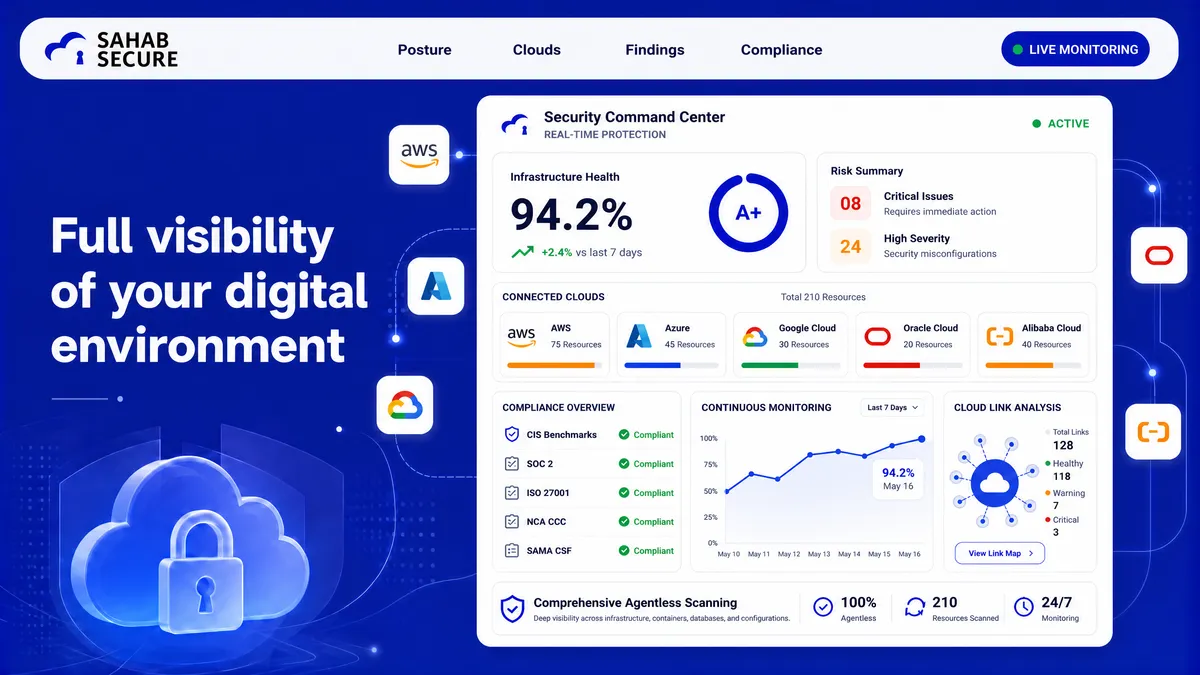
SahabSecure combines agentless cloud scanning, continuous monitoring, intelligent risk prioritization, and cloud-link analysis to help organizations identify misconfigurations, understand relationships between cloud resources, and prioritize remediation based on risk and business impact.
Its compliance capabilities provide a centralized view of how the cloud environment aligns with relevant frameworks, helping teams move from fragmented findings toward a more connected understanding of their control posture.
Compliance Is More Than Passing an Audit
Passing an audit is an important milestone.
But audit readiness should not be the only moment when an organization thinks about compliance.
Cloud environments are continuously evolving. A configuration that was compliant yesterday may no longer be compliant today. A newly deployed resource may introduce a control gap. A change in permissions may create a new security risk.
This means compliance is not simply a document that can be reviewed once a year.
It is a reflection of the organization’s current security posture.
The goal should therefore be more than being able to say:
“We passed the audit.”
It should be being able to say:
“We know where we stand today, what has changed, what requires attention, and why.”
That shift from periodic compliance checks to continuous compliance visibility is becoming increasingly important as cloud adoption grows and regulatory expectations become more complex.
One Platform. Multiple Frameworks. Clearer Visibility.
As organizations expand their use of cloud services, managing security and compliance through disconnected tools and manual processes becomes increasingly difficult.
The future of cloud compliance is not about creating more checklists.
It is about creating a continuous connection between security posture, cloud infrastructure, risk, and compliance requirements.
SahabSecure is built around this principle: helping organizations understand their cloud environment, map their security posture against the frameworks that matter to them, identify where gaps exist, and focus attention where it is needed most.
Because compliance should not only be something an organization prepares for before an audit.
It should be something the organization can continuously see, understand, and act on.